
🔥 7-WEEK GREEN STREAK then week 8 closed red — first losing week back
W1 W2 W3 W4 W5 W6 W7 W8
🔥 Member access: $60/mo → $50/mo Join If Ready
📺 Next Stream --:--:--
Results Blog Premium Guidance My Dashboard Stock Lab Options Lab Forex Calendar Discord TikTok Instagram
Trading Education · Live Tools · Discord Community

The Blueprint For Smarter Trading.

A simple trading education system for options, futures, stocks, and market news — built around discipline, live analysis, risk management, and community learning.

Learn The System Track The Market Avoid Bad Trades Join The Community
300+
Members
6
Green Weeks
INVEST
“The best investment you can make is in yourself.”
24h
News Radar
$0
Free Discord
↓ see what is included
Live analysis and trade planning
Premium lessons, checklists, and reviews
Stocks · Options · Futures · Forex News
Discord: St1101  |  Email: vjmtrading.contact@gmail.com
What You Get

Simple Enough To Use. Deep Enough To Grow.

The site is organized around four tools: learn the model, track the market, avoid major news traps, and review trades with a risk-first process.

01

Premium Blueprint Guidance

Step-by-step modules for setup, confluences, IFVG model, options basics, quizzes, final exam, and pre-trade checklists.

02

Stock Lab

Basic stock research, plus premium sector watchlists with a white TradingView workspace, optional indicator presets, Fibonacci zone builder, risk tools, source links, and auto-research panels.

03

Forex Factory Calendar

USD-only red/orange news calendar with impact filters, forecast/previous/actual values, direct source links, and a simple rule: know the news before entering trades.

04

Discord Community

Join free, learn the room, upgrade when ready, and use premium streams, trade reviews, and callouts as education rather than blind signals.

300+Members
6Green Weeks
4Core Tools
$50/moPremium Access

Free Value First. Paid Structure When Ready.

I am not building this to pressure anyone into buying. I trade whether people join or not. The free Discord, Stock Lab basics, Forex Factory calendar, Yahoo news links, risk reminders, and source links stay available so you can see the process first.

Premium is for people who want the organized version: live guidance, trade reviews, checklists, member tools, and a cleaner path through the noise. Valuable skills take time to teach well, and the membership is what makes it worth setting aside that time for serious students.

Join If You Are Ready Start Free First
Free side

Community access, basic stock research, news links, Forex Calendar, and educational reminders.

Premium side

Guidance, streams, reviews, member-only tools, and a repeatable decision process.

Fit check

No guaranteed profits. No pressure. Join only if you value structure, discipline, and learning the reasoning behind trades.

Start With The Right Path

A simple path so visitors know exactly where to go instead of guessing.

01
Join Free Discord

Get in the community first. Ask questions and see how the room works.

02
Watch Free Basics

Start with free education before using any callouts or advanced tools.

03
Upgrade To Premium

Join when you want live callouts, streams, reviews, and the full guidance.

04
Use The Stock Tracker

Research ratings, sectors, targets, TradingView charts, and Vinny's favorites.

05
Member Sign In

Already premium? Sign in to open your dashboard and member links.

Who This Is For — And Who It Is Not For

The best trading communities are honest about fit. This is built for structure, risk control, and education — not guaranteed profit promises.

Built For

  • Beginners who want a simple path instead of random chart noise.
  • Traders who want live analysis but still want to understand the reasoning.
  • Members who can respect risk, sizing, stop levels, and patience.
  • People who want tools, checklists, source links, and accountability.

Not Built For

  • Anyone looking for guaranteed profits or no-loss trading.
  • People who want to blindly copy every trade without learning.
  • Traders who full-port, revenge trade, or ignore risk rules.
  • Anyone unwilling to verify data, wait for confirmation, or accept losses.

Learn The Rules First

Before joining premium or following any trade idea, start with the basic rules that keep traders from chasing bad setups.

Risk

Define the invalidation before entry

A setup is not complete until you know where you are wrong, how much you can lose, and what confirms the idea.

News

Check the calendar before trading

High-impact economic events can move markets fast. Use the Forex Calendar before trading around CPI, FOMC, NFP, PMI, GDP, and rate decisions.

Charts

Wait for levels, not emotions

The Blueprint focuses on liquidity, FVG/IFVG structure, confirmation, and clean risk instead of random entries.

Open Forex Calendar Open Guidance

Eight Weeks. Seven Green, One Red.

A real track record has losing stretches in it. These examples show what the process produced, including the week it gave some back. Every figure is a past example, not a projection.

The full picture

Eight weeks, peak, then a red week

The account peaked around the low six figures on a Tuesday after seven green weeks. Week eight came back red. Showing both halves matters more than showing the peak alone — an equity curve that only goes up isn't a real one. What separates a manageable down week from a damaging one is sizing and a defined stop, decided before the trade, not after. That's the part of the run worth studying.

8 weeks documented 7 green · 1 small red Not typical results
Example trade
+507.71%
Apr 24, 2026 · QQQ 663 Call

Shown as percent gain instead of dollar P&L. The point is execution quality, timing, and risk control — not making the page feel like a highlight reel.

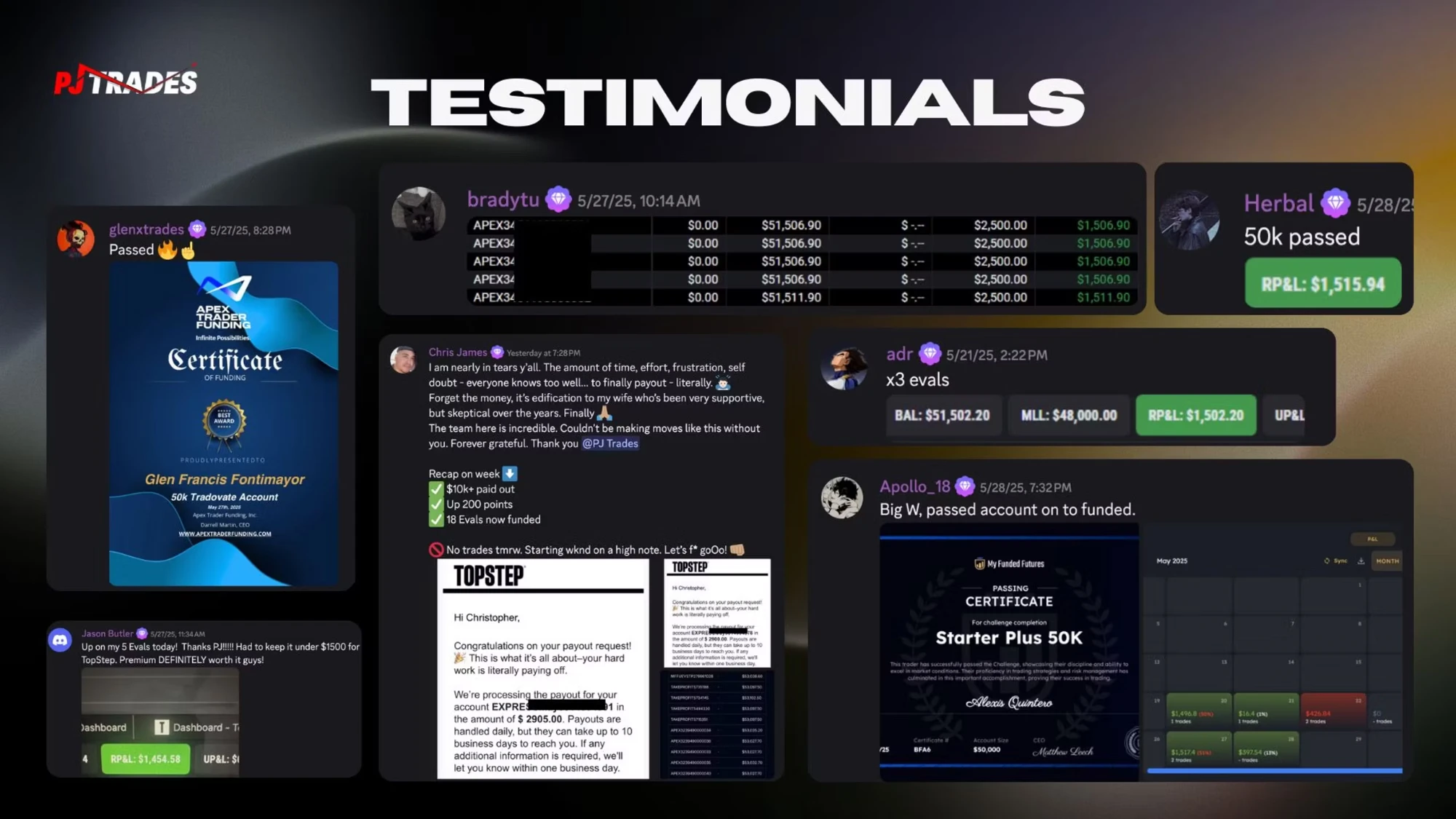
Proof standard: personal trade examples are shown as percentages only. Member cards show dollar + percentage where the source screenshot or trade note included both. Nothing here is a promise, income claim, or instruction to copy trades.

Chronological Examples, Percent Only

These are ordered by date when a date was available. Dollar P&L is intentionally left off the public page so the proof stays educational instead of feeling like a flex.

Feb 2026
CIFR 16 Call
+63.02%
Personal example · percent only
Apr 15, 2026
MSFT 407.5 Call
+129.53%
Personal example · percent only
Apr 16, 2026
QQQ 640 Call
+110.08%
Personal example · percent only
Apr 20, 2026
QQQ 645 Put
+140.76%
Personal example · percent only
Apr 23, 2026
QQQ 657 Call
+48.84%
Personal example · percent only
Apr 24, 2026
QQQ 663 Call
+507.71%
Standout example · not typical
Apr 29, 2026
GOOG 375 Call
+252.96%
Personal example · percent only

Member Cards With Dollar + Percent Context

Member examples stay compact: what was traded, the date if available, the dollar result, and the percentage result when it was included in the proof note. The goal is social proof without making the page feel loud.

Apr 24, 2026
SStryk3rr · GOOGL 340 Call
+$181
+125.70%
MemberSame callout
Apr 24, 2026
ali · GOOGL 340 Call
+$4,267
+125.70%
MemberSame callout
May 6, 2026
ali · QQQ 690 Call
+$537
+160.84%
MemberOptions
May 6, 2026
SexyMonkey · QQQ Call
+$908
+160.84%
MemberOptions
May 13, 2026
danny · GOOGL 400 Call
+$72
+80%
MemberFirst month covered
May 13, 2026
SexyMonkey · QQQ 713 Call
+$1,069
+362%
MemberFirst day premium
Weekly P&L
SexyMonkey · Options
+$1,862
+144% week · +239% day
MemberShared win

The Math Isn't Symmetrical

The reason discipline gets emphasized so much isn't motivation — it's arithmetic. Losses and gains don't cancel out evenly, which is why keeping losses small matters more than catching big winners.

-50%
needs +100% to recover

A 50% loss doesn't need a 50% gain to get back — it needs to double. This gap widens fast the deeper the drawdown, which is the whole case for cutting losses early.

1–2%
risked per trade

Sizing each trade so a single loss costs a small slice of the account is what lets you survive a string of losers without being forced out. Position size is decided before entry, not during.

Edge × Reps
consistency beats intensity

A modest edge only shows up over many trades taken the same way. One oversized "conviction" trade can erase a month of disciplined ones — which is why the same rules apply to every setup.

Bottom line: the goal isn't to win every trade — it's to make sure no single trade or week can take you out of the game. The strategy is what finds the setups; risk control is what keeps you around long enough for them to matter. Educational only, not financial advice.

Weekly Consistency

Each week gets logged and reviewed — wins and losses both. Tracking it this way keeps the attention on whether the process held up, not on any single result.

W1
Reviewed
W2
Reviewed
W3
Reviewed
W4
Reviewed
W5
Reviewed
W6
Reviewed
W7
Green week
🔻
W8
Small red

Eight documented weeks: seven green, one small red. The red week is kept on the board on purpose — a track record that hides its losses isn't worth much. Keeping the down weeks small is what makes the green ones add up. Examples only, not guaranteed.

What Kind of Trader Are You?

Answer 3 questions honestly. No sugarcoating.

1 of 3 — You're in a trade and it's down 20%. What do you do?

📈 Growth Simulator

Trading daily gains or long-term investing — your choice.

Gain type:

⚡ Options Calculator

Calculate P&L on a options trade instantly.

🎯 Risk/Reward Calc

Know your R:R before you enter — discipline starts here.

Premium Dashboard

Join premium, sign in, check your status, and open every member resource from one clean hub.

Premium is for members who want structure: the guidance, live market tools, trade reviews, news awareness, and a community focused on learning the process — not chasing guaranteed outcomes.

🔥 Launch Special First 20 Members Get $50/mo — Save $10
Spots claimed:
$50/mo
$60

First 20 members lock in $50/mo — after that it's back to $60

  • Live daily callouts with in-depth analysis
  • Premium-only live streams with Q&A
  • Exclusive trade reviews
  • Direct access — message Vinny personally
  • Premium Discord channels
  • Options · Futures · Stocks coverage
  • Cancel anytime — no contracts
VJM20

Use code VJM20 + referrer's name in Venmo note → 20% off first month

Pay via Venmo — @vinny_mistretta

After payment, DM St1101 on Discord or email vjmtrading.contact@gmail.com. Your access instructions are sent privately after membership is confirmed.

⚠️ Important: Include your Discord username or email in your Venmo payment description.
📘 The Blueprint Guidance

The first Start Here window is free. Full setup modules, confluences, the IFVG model, options lessons, quizzes, final exam, and checklists unlock after member sign-in. The access code is sent privately through Discord DM or email after payment — it is not published on the site.

Open Guidance

Already paid? Use the Sign In tab or open the guidance and enter the code you were sent.

Services & Booking

Beyond the Discord — 1-on-1 sessions for serious traders who want direct, personalized attention.

Most Popular
💎

Premium Membership

Daily callouts, live streams, trade reviews, premium Discord — everything.

$50/mo
$60

Optional founding price while available

Get Access
📊

Portfolio Review

1-on-1 deep dive into your current holdings. What to keep, what to cut, what to watch.

$100/session
Book via Email
📈

1-on-1 Bootcamp

Beginner to executing real trades. Full personalized session — no fluff, just what matters.

$100/session
Book via Email

Email vjmtrading.contact@gmail.com or DM St1101 on Discord to book a session.

300+
Members
PROCESS
Risk first
6 WKS
Documented stretch
1 SETUP
Repeatable focus

"The best investment you can make is in yourself."

— Warren Buffett

🎵
TikTok
@vinny.mistretta0
📸
Instagram
@vinny.mistretta1
💬
Discord
St1101 · 300+ members

I Was You.
Then I Figured It Out.

I started where most beginners start — too much information, too many opinions, and no simple process. After testing different methods and learning from multiple mentors, I realized the edge was not more noise.

What actually moved the needle was simplicity, discipline, and repeating one clean setup at a time. That is the way I try to teach: practical, direct, and risk-first.

There was one larger six-week stretch that I keep as motivation. I do not present it as typical. The real lesson is that discipline, timing, and risk control matter more than the dollar amount.

I cover stocks, options, and futures. On crypto — only BTC, ETH, and XRP. Meme coins are gambling, not trading. I keep it simple because simple works. I've helped people who said they'd never understand the market. I simplify everything down to where anyone can follow along.

The high failure rate in trading isn't from lack of information. It's from lack of discipline, impatience, and trying to skip the process. I teach the information and constantly reinforce the mindset. Both matter equally.

Self-Taught Options Futures Stocks BTC · ETH · XRP Discipline-First 300+ Members
Get Premium — $50/mo Free Discord

⚠️ Not financial advice. All content is educational. I am not a licensed financial advisor.

"
The best investment you can make is in yourself.
— Warren Buffett
"
The stock market is a device for transferring money from the impatient to the patient.
— Warren Buffett

The Art of Discipline

Why Knowing the Rule Is Not the Same as Following It — a research-backed essay on trading psychology, behavioral economics, and the system that actually separates winners from losers.

📖 Research Essay · Trading Psychology · ~15 min read · Free to Read
Knowledge-Execution Gap Prospect Theory Loss Aversion Disposition Effect Self-Control vs Grit Implementation Intentions Behavioral Economics Position Size Paradox Emotional Regulation Revenge Trading Day Trading Psychology Kahneman & Tversky Duckworth & Gross Gollwitzer Odean 1998

📋 Contents

① The Knowledge-Execution Gap ② Trading as Pressure Chamber ③ Self-Control vs Grit ④ Prospect Theory ⑤ The Disposition Effect ⑥ Position Size Paradox ⑦ Beginners vs Veterans ⑧ Building It as a System

"Discipline is not a personality trait or a motivational slogan. It is the ability to follow rules despite pressure — in both markets and all other aspects of life."

— Vinny Mistretta

Today, almost everyone can access tools that were previously reserved for professionals. With a cellphone, a person has instant access to a stock brokerage or trading app. Gym memberships are affordable and located everywhere. A computer possesses more information than an entire library. But having access does not mean people will use it effectively.

The real challenge is using these resources consistently, especially in environments built to exploit impulse and emotion. The "knowledge-execution gap" explains this clearly: infinite access does not automatically come with the discipline necessary to succeed. This gap is the distance between knowing the correct answer and actually executing it once pressure, temptation, and emotion begin to cloud judgment. In high-stakes environments like financial markets, this gap is not simply personal — it is also structural.

The problem is that discipline is often treated as a fluctuating mood rather than a measurable, structured process. While this paper analyzes discipline through a trading lens, the same disciplinary failures are apparent in fitness, school, work, health, relationships, and any area where people know the right action but struggle to commit to it.

Across fields such as athletics, academics, entrepreneurship, and personal finance, the same pattern appears: people rarely fail because they lack information. They fail because they cannot apply what they already know consistently.

Talent, intelligence, and opportunity all matter, but none of them compensate for inconsistency under pressure. Discipline is the quality that converts knowledge into results, goals into habits, and intentions into action. It is the quality that strengthens every other trait, because without it, even the best strategy or ability can collapse the moment emotion, boredom, or discomfort arises.

Trading as a Pressure Chamber

Discipline is the ability to execute a system when short-term emotion conflicts with long-term goals. Day trading is an ideal pressure chamber for studying discipline because it compresses temptation, feedback, money, uncertainty, and emotion into seconds or minutes — revealing that people often fail more from inconsistency than from lack of knowledge. Markets are noisy, short-term outcomes are often random, and factors such as fees, slippage, and informational disadvantages all increase losses. But even when a strategy has an edge, that edge collapses without disciplined execution.

Some critics argue that the high failure rate among traders is not attributed to a disciplinary problem — it is the complex structure of the markets. They claim that professional firms, high-frequency algorithms, and a lack of information create an environment that is disproportionately against retail traders. This is a fair point. However, this claim reduces two separate problems into one. The question of whether a strategy has a genuine edge is different from the question of whether a trader executes that strategy when it matters.

Research consistently shows that traders with documented strategies still underperform compared to their own systems due to emotional interference, impulsive decisions, and inconsistent rule adherence. The most common documented losses among retail traders are not caused by a market that is simply too difficult to beat — they are caused by behavior that directly contrasts the trader's own stated plan: revenge trading, holding losers too long, and cutting winners too early. Discipline is not being claimed to guarantee profits, but without it guarantees unnecessary losses compounded with the structural disadvantages that could already exist.

Self-Control vs. Grit — They're Not the Same

Duckworth and Gross help explain why access does not automatically translate into execution. People often confuse wanting a long-term outcome with having the ability to resist short-term temptation. They argue that two important determinants of success are self-control and grit — defining self-control as the "capacity to regulate attention, emotion, and behavior in the presence of temptation" and grit as "the tenacious pursuit of a dominant superordinate goal despite setbacks." These concepts are related but not identical. Someone might handle short-term temptation well while struggling to stay committed long-term. Another person may deeply care about a long-term goal but struggle to regulate immediate impulses.

Gollwitzer strengthens this point by demonstrating that intentions alone are weak predictors of behavior — accounting for only about 20% to 30% of behavioral variance. He argues that this problem improves when people form specific implementation intentions that connect a future situation to a predetermined response. Together, these sources reinforce the argument: discipline matters more than raw knowledge. This shows the knowledge-execution gap at its simplest level.

Key insight: Intentions alone account for only 20–30% of actual behavior. The gap between what you plan to do and what you actually do under pressure is where discipline lives.

Prospect Theory — Why Losing Feels Worse Than Winning Feels Good

In Prospect Theory, Kahneman and Tversky argue that people evaluate outcomes relative to a reference point rather than in absolute terms, and that losses feel more painful than equivalent gains feel rewarding. Because of that, a trader who is down on the day is more willing to take irrational risk in order to get back to "even," while a trader who is up may become overly quick to lock in profits for emotional relief.

This same loss aversion also helps explain why traders cling too tightly to unrealized gains — because the pain of giving back profit can feel more immediate than the potential benefit of letting the trade develop. Traders anchor to emotionally meaningful reference points and resist exiting until the price reaches those internal thresholds. This leads to predictable patterns: after losses, traders increase their risk, and after gains, they do the opposite. Rule-breaking, then, is not random. It follows recurring psychological patterns that emerge whenever a person's short-term emotional reference point begins to overpower the longer-term system.

The Disposition Effect — Real Data, Not Just Theory

Odean's research confirms that these conflicts — especially the tendency to cut winners and hold losers — are not just theoretical. In his study of 10,000 brokerage accounts, investors demonstrated a strong tendency to realize winners more readily than losers. More importantly, the winning trades that investors chose to sell continued to outperform the losing positions they held. This makes the disposition effect one of the clearest real-world examples of rule-breaking under pressure.

Investors did not merely think irrationally under pressure — they behaved in ways that damaged their later performance. This matters because it shows how emotional relief can override rational decision-making. Traders frequently violate their known process by favoring comfort in the moment over better probabilities in the future.

The Position-Size Paradox

Emotional engagement complicates this problem further because a strategy can remain identical while its psychological difficulty changes dramatically. Bossaerts and colleagues found that heart-rate changes that anticipate mispricing events are associated with stronger earnings, while heart-rate changes that react to trades are associated with weaker earnings. Their conclusion: emotion must not disappear from trading, but the timing and regulation of emotion matter.

This is where the position-size paradox becomes especially important. A setup that appears rational and manageable at a small size can feel entirely different once the exposure becomes large enough to threaten comfort, confidence, or control. The setup remains unchanged, but the trader does not. As size increases, each price movement feels more intense, and adhering to the plan becomes even harder. Discipline, therefore, cannot depend on feeling calm. It must be strong enough to withstand changes in internal state — especially when position size amplifies the emotional weight of the trade.

Experience by itself does not solve this problem. 80% of all day traders quit within two years, yet traders with a history of losses still account for over half of day-trading volume. Without honest feedback loops, experience can reinforce ego just as easily as it reinforces skill.

Beginners vs. Veterans — How They Measure Themselves

Beginners often evaluate themselves through profit and loss alone. After a profitable day, they assume they traded well; after a losing day, they assume they traded poorly. Veterans are more likely to judge performance through process: Did I follow my plan? Did I respect my risk rules? Did I size appropriately? Did I violate my structure?

That shift is critical because it separates identity from immediate outcomes. A losing trade that follows a sound process can still be evidence of discipline, while a winning trade that violates a rule can still be evidence of failure. Long-term traders survive not because they predict every move correctly, but because they treat probability management, emotional regulation, and structural consistency as more important than short-term validation.

The Platform Problem — When the Environment Works Against You

Studies on the gamblification of investing argue that certain platforms borrow from gambling by emphasizing rapid feedback, stimulation, and repeated engagement. Barber et al. show that Robinhood's simplified attention structures guide users toward concentrated buying — and that the most purchased stocks are followed by average 20-day abnormal returns of -4.7%.

When platforms highlight trending stocks or reward constant interaction, they eliminate the friction that could otherwise prevent impulsive executions. In that kind of setting, discipline is no longer just a private internal trait — it becomes a struggle against an external design that benefits from speed, stimulation, and repetition. The trader is not only fighting emotion; they are also fighting an environment designed to turn attention into action before reflection can intervene.

Building Discipline as a System

For that reason, discipline must be built as a system. Implementation intentions matter because they reduce the knowledge-execution gap by moving the decision from the heated moment of temptation to the earlier cold moment of planning. Rather than in-the-moment decision-making, people link a critical situation to a predetermined action:

  • If I take two consecutive losses, then I step away
  • If I feel the urge to size up out of emotion, then I cut my size in half
  • If I break one rule, then I stop trading for the session
  • If the chart does not match my setup, then I do not enter — period

This kind of planning makes the response more automatic, so the trader does not have to rely on willpower in the heat of the moment. Checklists, hard daily loss limits, position-size caps, and honest journaling systems all work by making it harder to violate the plan than it is to follow it. At that point, discipline becomes measurable. It becomes visible in whether a trader executes the system when pressure arises or succumbs to short-term temptation.

The Bottom Line

Ultimately, trading is a useful case study not because it is the only place where discipline matters, but because it exposes the problem more quickly than ordinary life does. In fitness, school, work, or budgeting, weak discipline can hide behind a delay. Trading eliminates that delay. It shows that modern failure is often caused not by lack of access, knowledge, or tools — but by the inability to follow a structured process once emotion begins to compete with judgment. Discipline is the foundation that every other skill depends on. That consistency determines survival long before it determines success.

Works Cited

Barber, B. M., Huang, X., Odean, T., and Schwarz, C. "Attention-Induced Trading and Returns: Evidence from Robinhood Users." The Journal of Finance, vol. 77, no. 6, 2022, pp. 3141-3190.

Barber, B. M., Lee, Y., Liu, Y., and Odean, T. "Do Day Traders Rationally Learn About Their Ability?" 2017.

Bossaerts, P., Fattinger, F., Rotaru, K., and Xu, K. "Emotional Engagement and Trading Performance." Management Science, vol. 70, no. 6, 2023, pp. 3381-3397.

Duckworth, A. L., and Gross, J. J. "Self-Control and Grit." Current Directions in Psychological Science, vol. 23, no. 5, 2014, pp. 319-325.

Gollwitzer, P. M. "Implementation Intentions." American Psychologist, vol. 54, no. 7, 1999, pp. 493-503.

Kahneman, D., and Tversky, A. "Prospect Theory." Econometrica, vol. 47, no. 2, 1979, pp. 263-291.

Newall, P. W. S., and Weiss-Cohen, L. "The Gamblification of Investing." International Journal of Environmental Research and Public Health, vol. 19, no. 9, 2022.

Odean, T. "Are Investors Reluctant to Realize Their Losses?" The Journal of Finance, vol. 53, no. 5, 1998, pp. 1775-1798.

Want to apply this? The discipline system is built into every callout inside the Discord.

Join the Free Discord

Insights & Analysis

Deep dives into the economy, markets, and trading psychology — written by Vinny for the community.

Economy

What the Fed's Next Move Means for Your Portfolio

Interest rate decisions ripple through stocks, bonds, forex, and crypto. Here's how to position before the next FOMC decision.

📖 7 min read Economy · Macro
Options

Why 90% of Options Traders Lose Money (And How to Be in the 10%)

The math is simple. The execution is not. Position sizing, expiry selection, and IV awareness are the three pillars most retail traders skip.

📖 10 min read Options · Risk
Tech & Markets

How AI Is Reshaping Stock Market Analysis in 2026

From algorithmic trading to earnings prediction, AI tools are changing who has the edge. What retail traders need to know right now.

📖 8 min read Tech · AI
Trading Psychology

The Art of Discipline — Research Essay

A deep research-backed breakdown of why discipline is the only edge that can't be back-tested. Kahneman, Tversky, Duckworth — applied to trading.

📖 15 min read Free · Full Essay
Read Essay ↓
Stock Market

S&P 500 Sector Rotation — Where Smart Money Is Moving

Money rotates between sectors before the price does. Understanding rotation gives you a roadmap the headlines won't tell you about.

📖 6 min read Stocks · Sectors
Forex

How to Trade Around CPI, FOMC, and NFP Without Getting Wrecked

High-impact economic events can destroy positions in seconds. Here's the exact playbook: when to stand aside, when to size down, and when the risk is worth it.

📖 9 min read Forex · News Trading
Open Forex Calendar

Full essays and market breakdowns are posted in the Discord first.

Join Free Discord

FAQ — Real Answers

No fluff. The questions everyone asks before joining.

Is premium actually worth it?
Premium is worth it only if you actually use the structure: show up, study the reasoning, manage risk, and review your trades. I share wins as proof that the process can work, but I do not promise outcomes. Start free first, watch how the room operates, and join only when the organized guidance is worth your time.
I'm a complete beginner — can I keep up?
Yes. I built this specifically so a beginner can follow along. I explain everything — the setup, why I'm taking the trade, what I'm looking for, where to enter, where to exit. I've helped people who said they'd never understand the market. If an elementary school kid can follow it, you can follow it. The free Discord is a good place to start before going premium.
What if I miss a callout?
Every callout is posted in the Discord with the entry, reasoning, and target. You don't have to be glued to a screen — you can check in between work or school. That said, options move fast and timing matters. The stream from 9:15 AM to 2 PM ET is where most of the real-time action happens. The more present you are, the more you get out of it.
Can I lose money following your callouts?
Yes — and I'll always be straight with you about that. Trading involves real risk and no callout is guaranteed. I have losing days. Everyone does. What separates members who succeed from those who don't isn't whether they win every trade — it's whether they manage their risk properly, size appropriately, and follow the system consistently. I teach all of that. But discipline is on you.
What exactly do I get with premium?
Premium includes member guidance, live streams, trade reviews, premium Discord areas, Stock Lab tools, callout context, and direct support. The goal is not blind copying — it is learning how to read the setup, manage risk, and understand why a trade is or is not worth taking.
How do I get access after paying?
Pay via Venmo (@vinny_mistretta) and include your Discord username in the payment description. Then DM me on Discord (St1101) or email vjmtrading.contact@gmail.com. I'll assign your Premium role and send you the site password manually — usually within a few hours, often faster.
What markets do you cover?
Stocks, options, and futures — primarily QQQ, SPX, GOOGL, MSFT and other high-volume names. On crypto I only cover BTC, ETH, and XRP — the only three with real institutional adoption. Meme coins are gambling, not trading, and I don't touch them.
Can I cancel anytime?
Yes — no contracts and no pressure. If premium is helping, stay. If it is not the right fit, do not renew. The free Discord and free tools are still there.
Why should I trust you?
I do not ask you to blindly trust me. I share results, member examples, live streams, and risk rules so you can judge the process first. The larger six-week run is shared as motivation, not as a promise that anyone will get the same result.

Still have a question? DM St1101 on Discord or email vjmtrading.contact@gmail.com

Join the Discord

Free access, live chat, market reminders, and a place to ask questions before deciding whether premium is right for you.

Join Free — Discord

Discord: St1101  |  Email: vjmtrading.contact@gmail.com

Educational FirstThe site teaches process, risk, source checks, and trade review. It is not personalized financial advice.
Source-Linked ToolsThe tracker links out to multiple research sources so members can compare data before acting.
Clear Risk LanguageResults shown are examples, not guarantees or typical outcomes. Losses happen.
Simple PathFree Discord first, premium guidance when ready, stock lab and Forex calendar for daily prep.

Important Risk Disclosure: All content on this site is for educational and informational purposes only. It is not financial, investment, tax, legal, or accounting advice. Trading stocks, options, futures, forex, and crypto involves substantial risk, including the possible loss of principal. Past performance, screenshots, testimonials, callouts, or examples do not guarantee future results and should not be treated as typical outcomes. Always verify data from source links, define your own risk, and consult a licensed professional before making financial decisions.

Join PremiumForex Calendar